In digital product design, you’ll often have to do usability tests and A/B tests to improve overall UX quality. These common UX tests usually involve real user traffic and real users, so traditional, human-oriented UX testing can consume more time and be costly. A/B or multivariate testing on real traffic can negatively affect product reputation when a specific design version performs poorly, wasting precious incoming traffic. Usability test failures and pain points can frustrate real users who often volunteer for usability tests.
What if you can do UX testing without real traffic and real users? AI agent simulation is a futuristic UX testing technique that helps designers do A/B tests and usability tests using AI-simulated users.
Let’s understand how AI agent simulation for UX testing works and compare it with human-centered, traditional UX testing to decide when to use each to evaluate UX effectively by balancing accuracy and cost.
What are AI-simulated users?
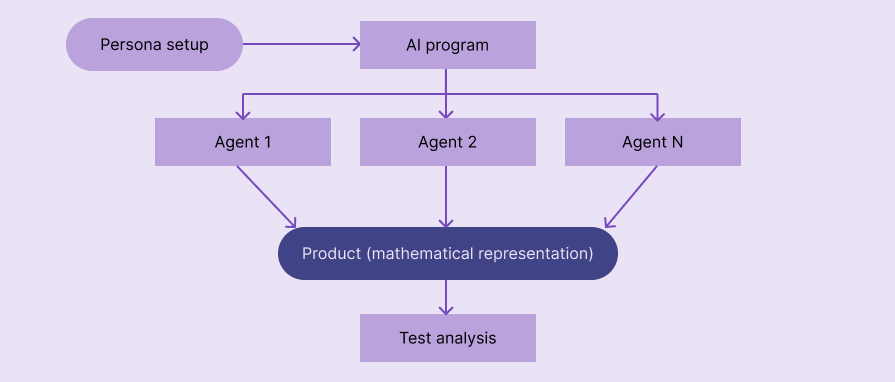
AI-simulated users are virtual digital product users created through an AI model. They have predefined UX personas that interact with digital product interfaces to achieve goals by mimicking real human user behavior.
An AI-powered A/B testing or usability testing automatically spawns AI-simulated users during a test based on UX persona configurations:
How do AI agent simulations work in UX tests?
AI-powered UX testing tools use the following generic steps to create and use AI-simulated users:
- Uploading designs and user flows: In the initial stage, designers upload product designs along with user flows that need to be tested to the AI-powered UX testing platform. They either upload high-fidelity prototypes (e.g., Figma files) or enter the live URL to the product by describing user flows
- Defining personas: Configures the characteristics of virtual users by defining common UX persona attributes like tech saviness, behavior, pain points, etc. Testing tools may offer auto-generated personas by allowing adjustments to improve productivity
- AI interaction: Testing will begin with AI-simulated users for the selected design at this stage. The AI-powered test platform evaluates the user flow and UI characteristics for each virtual user, usually by calculating interaction probabilities
- Result interpretation: The AI-powered test platform will output a Boolean design decision with quantitative results for an A/B test and usability insights (usually pain points and feedback) for a usability test. This result looks the same as a human-focused, non-AI UX test with a high accuracy score and decision-making power, even if the user base wasn’t real
Benefits of AI-simulated testing
Using AI-simulated A/B or usability testing has the following benefits:
- Accelerates iterations: A human-focused UX test may take minutes to weeks, since they depend on real incoming traffic and real personas, but AI-simulated testing can generate results in seconds. For example, you can conduct a two-week A/B test in seconds using AI
- Reduces risk: UX tests on a real user base can negatively affect product reputation when users receive A/B test variants they dislike and face pain points, but AI-simulated testing never affects the original user base since the real users are never used as testers
- Saves traffic: Your product won’t lose conversions due to A/B or multivariate testing variants since AI handles all your tests — not the real users. Even if you A/B test the worst two design versions, the real incoming traffic won’t be wasted
- Scalable and dynamic: Can instantly increase users with dynamic personas on demand to satisfy your test requirements
Limitations of AI-simulated testing
While AI-simulated users bring benefits, it also comes with the following noticeable drawbacks:
- Accuracy issues for unique designs: AI agents learned from training data, and improved knowledge from recent tests, so the AI test system may create less accurate results for unique product designs since AI agents can’t innovate or be creative like human users
- Missed human UX psychology: You can’t assume that real human users will behave the same as virtual AI-generated personas — virtual users miss the human UX parts, such as perception, emotions, cognitive boundaries, and physical skills that affect product interaction
- Interaction and evaluation bias: AI-simulated user interactions are evaluated based on probability scores, and interactions depend on the quality of the training data set, but real users interact and evaluate product interfaces based on their unique digital product literacies
Practical advice for designers: when to trust AI-simulated vs. real users
Both simulated and real users are helpful in different test scenarios. Let’s understand when to use each. Here is a quick summary of the AI-simulated vs. real users comparison:
| COMPARISON FACTORS | AI-SIMULATED USERS | REAL USERS |
| Evaluation speed | Extremely fast | Slow |
| Affects product reputation scores | No | Yes |
| Scability | Very high | Depends on traffic and user availability (usually low) |
| Decision-making reliability | Low | High |
| Suitable for | Early-stage, low-risk design evaluation | Later-stage, high-risk design evaluation |
AI-simulated users are so fast but have accuracy issues, so they can be trusted for testing low-risk test scenarios where you need a design direction — not accuracy, like the early UX tests or running pre-tests (tests before real tests). Real users represent actual user interaction, so they can be trusted for high-risk test scenarios like the final UX tests
Conclusion
AI agent simulation in UX testing is a new UX evaluation trend that helps designers make early design decisions without affecting the real user base. It can also be used to conduct pre-A/B or multivariate tests to create better variants for real tests.
FAQs
Will AI-simulated users interact with the product as automated testing (e.g., Selenium)?
Not exactly, AI-simulated users will go through user flows, but inside the AI model by interacting with a mathematical representation of the product — not the real product
Can I skip real A/B tests by doing an AI-simulated A/B test?
No, an AI-simulated A/B test isn’t a replacement for a real A/B test since pre-trained AI models can’t create your exact user base virtually
The post AI agent simulations for UX testing: When to use simulated vs. real users appeared first on LogRocket Blog.