Heroku at KubeCon Recap: Meeting Builders Where They Build
Read the original on heroku.com ↗KubeCon in Salt Lake City was amazing this year. Spending time with and engaging the cloud-native community provided insight into what developers need as AI workflows and AI-assisted code move into production.
During our keynote on the main stage, we shared how Salesforce uses Heroku to securely host more than 20k apps using cloud-native technology, including apps built by citizen developers. We talked about how Heroku Fir, Kubernetes, OpenTelemetry, and Cloud Native Buildpacks power the architecture at scale.
It didn’t stop there: we joined practitioners from Salesforce and ConfigHub for a packed Birds of a Feather session on platform configuration, and developers stopped by our booth to get hands-on for a sneak peek of our one-step deployments from their favorite agentic harness.
What we shared on the stage and floor at KubeCon
Between our main stage keynote, community discussions, and booth demos, we spent the week showing how modern cloud-native infrastructure powers Heroku. Here is a rundown of what we brought to Salt Lake City.
Keynote: Salesforce runs on Heroku
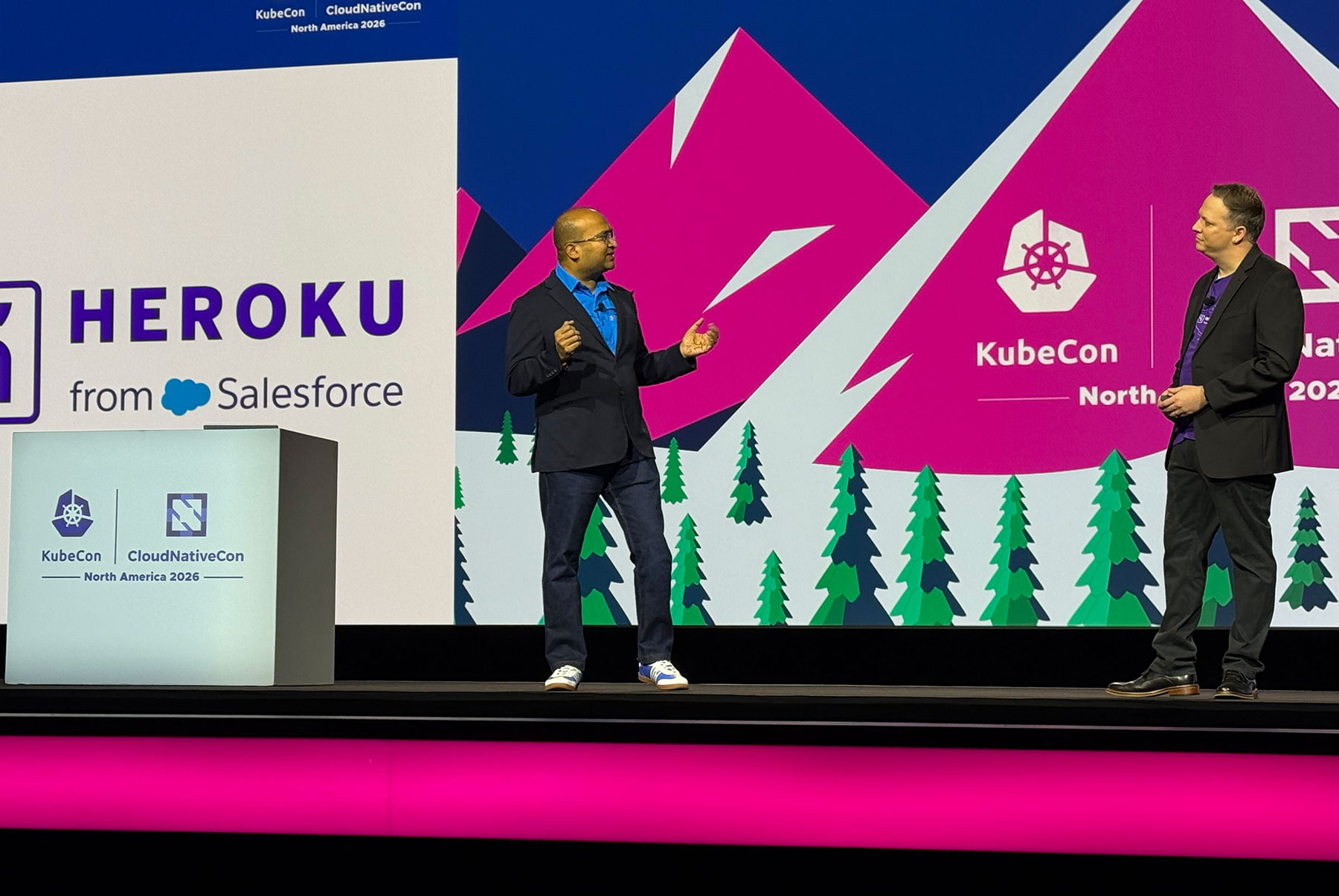
Brandon Schoen and Shiva Nimmagadda took the stage before thousands of attendees to share how internal teams rely on Heroku to ship fast and securely in their keynote “Salesforce Runs on Heroku: How We Empower Every Builder at Cloud Native Scale”.
They showed how Salesforce uses Cloud Native Buildpacks for language & framework flexibility and image rebasing to patch base OS vulnerabilities across thousands of apps in seconds without rebuilding code. Platform guardrails manage scale, isolation, and security while builders focus on shipping customer value.
Cloud Native Buildpacks CNCF graduation
We also celebrated a huge milestone for the Cloud Native Buildpacks project, which graduated from CNCF earlier this year. Heroku invented buildpacks to turn source code into runnable apps without manual container configuration, and we co-founded the Cloud Native Buildpacks project to bring that workflow to open source standards. The Cloud Native Buildpack project graduated earlier this year!
Supporting open source projects like this is central to how we build. Today, Cloud Native Buildpacks power image creation in Heroku Fir, connecting our open source roots directly to our newest cloud-native architecture.
Discussing where authoritative platform configuration belongs
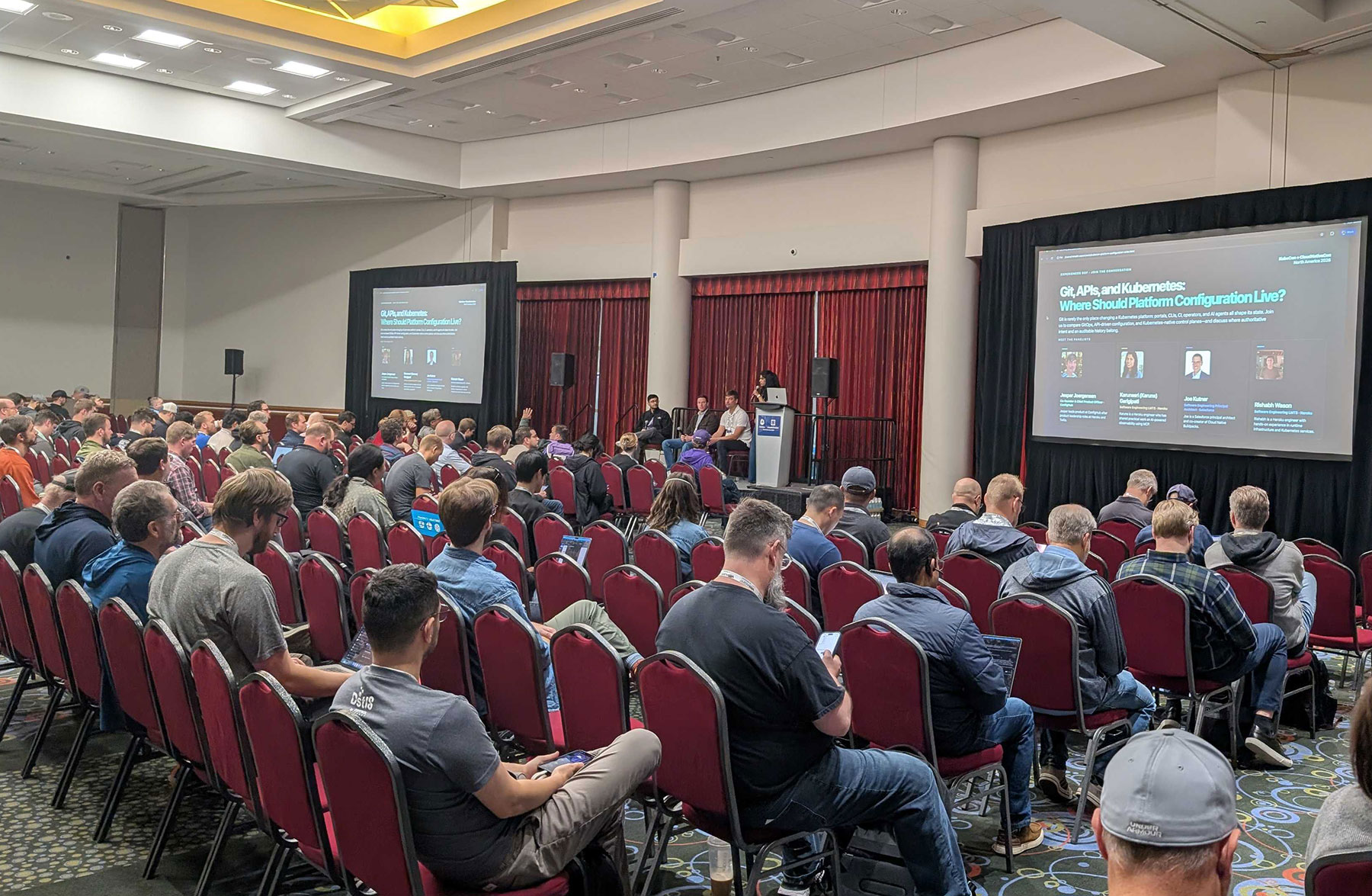
Our Birds of a Feather session brought together engineers to discuss where authoritative platform configuration belongs across API-driven models, GitOps, and Kubernetes-native control planes. Heroku engineers Karuna Garigipati and Rishabh Wason led the room alongside Joe Kutner from Salesforce and Jesper Joergensen from ConfigHub.
Testing and scaling AI-generated code with secure one-step deployments
At our booth developers and tech leaders got hands-on with one-step deployments from their favorite agentic harness. Builders working with an LLM spun up isolated, secure live previews directly on Heroku and then claimed them right into their Heroku accounts, moving from idea to production as quickly as they could prompt.
What developers and tech leaders are prioritizing right now
Outside of our sessions, our team spent the week talking with developers and tech leaders on the floor. Two themes came up in almost every conversation:
- Security and governance are urgent priorities as AI workflows and citizen-built apps scale inside enterprises. Leaders want their teams to build fast with AI tools, but they need strict guardrails, isolation, and automated patching before any generated code reaches production.
- There is strong affinity for Heroku from leaders who built their early products and careers on the platform. Many of them had interest in how we’re evolving and innovating so they can bring that same Heroku developer experience to their modern workloads.
That feedback connects directly to where we are taking Heroku next. Leaders don’t want to choose between builder velocity and enterprise security, and our upcoming platform capabilities are built to deliver both.
What’s next on the Heroku roadmap
Developer workflows are changing fast, and we are innovating right alongside them. Our goal is to meet builders where they already work, whether that is inside an AI coding assistant, a CLI, or a Salesforce org.
We are shipping new platform capabilities that bring secure infrastructure directly into those tools. Here is what is coming next on the Heroku roadmap.
A native compute layer extending Salesforce
Elastic Compute is a native compute layer extending Salesforce, combining modern languages and frameworks with secure Salesforce connectivity and consumption-based pricing through Flex Credits. Augment AI applications and run API services within the Salesforce trust boundary, in the language of your choice.
Easy, secure, one-step deployments from a builder’s favorite agentic harness
Our demos at KubeCon were an early sneak peek at what we’re building: Builders can preview AI-generated code directly on Heroku directly from their preferred LLM. Shareable, isolated, and secure by default.
Looking ahead, we are meeting all builders, including citizen developers, right where they work. Our focus is on delivering secure guardrails to enterprises so every team member can safely iterate and scale their apps from early prototypes to production.
Watch our keynote
Salt Lake City showed us that the Heroku community is as engaged as ever. We are excited to keep building the tools you need to ship secure, scalable applications without the operational overhead.
If you missed us at KubeCon, you can watch the full keynote recording, Salesforce Runs on Heroku: How We Empower Every Builder at Cloud Native Scale, right now on YouTube.
The post Heroku at KubeCon Recap: Meeting Builders Where They Build appeared first on Heroku.