How to resolve cross-functional conflict in AI product development
Read the original on blog.logrocket.com ↗AI products and features bring on more challenges than just adapting to the latest technological trends. As a product manager, you also have to handle the unique hurdles that AI products bring. Legal needs reassurance of compliance, engineers want more time to fine-tune, and executives pressure you to ship before your competitors do.
With so many competing AI priorities, PMs need to develop their cross-functional collaboration skill set to prevent legitimate concerns from becoming delay blockers. In this article, I go through a simple conflict-diagnosis framework designed to help move AI products forward.
Why AI products create cross-functional conflict
The goal posts have moved on launch-readiness for AI products. There’s a host of issues to consider from compliance, data quality, and integration problems. Every team will need their hurdle addressed. You may mistake this as a feature prioritization issue, but it’s really a matter of how much risk a team is willing to take on.
Familiar PM instincts like alignment meetings, consensus-building, and pushing toward a deadline can fail when the team is facing unpredictable outputs and unevenly distributed risk. Many teams face trying to decide what’s safe enough to release.
Given the multitude of layers to releasing a secure AI product, it’s essential for you to use a framework to get to the heart of the disagreement before trying to solve it.
A 3-step framework for resolving AI product conflicts
When faced with AI disagreement, I use the following three step framework.
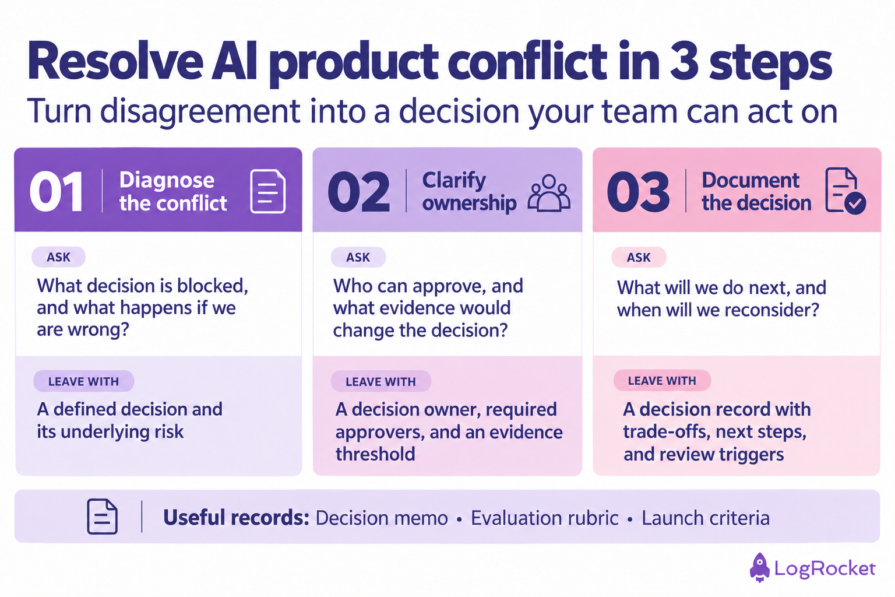
Step 1: Identify the blocked decision and underlying risk
In traditional product management, cross-functional conflict may have stemmed from different personalities and politics clashing with each other. But now there are competing priorities from several different teams.
To get to the root of the problem, start by asking these questions:
- What decision is blocked? Determine what’s making the development stall. For example, say the security team has concerns about the risk of data exposure
- What are we uncertain about? Identify the assumption each side is challenging. The security team is unsure whether customer data is adequately protected
- What happens if we’re wrong? Define the likely consequences on customers and the organization. A data breach has legal ramifications and leads to a loss of public trust
- Who can accept the remaining risk? Input and approval aren’t the same thing. You need to identify the person who can approve a legal, security, quality, or customer-impact risk
- What evidence would change the decision? Agree on a proposed solution. Testing a proposed safeguard can help prove it will reduce harm and get the green light from security
Step 2: Clarify decision ownership and required evidence
Once you diagnose the conflict, move on to naming the associated risks, potential solutions, and approvers for the next action step. You can also pick which artifacts to use to help make your case and ensure alignment.
Here’s what that could look like based on the conflict:
| Conflict type | The decision the team is really making | Who owns the risk decision? | What evidence or condition moves it forward? | Useful artifact |
| Speed | Is a smaller, limited, or delayed launch worth the tradeoff? | The product leader responsible for release scope, with required input from engineering and any affected risk owner | Evaluation results, rollout limits, monitoring plan, and rollback conditions | Decision memo and launch criteria |
| Quality | Is the model reliable enough for this use case? | The product leader responsible for release scope, with required input from engineering and any affected risk owner | Evaluation thresholds, known failure modes, human-review requirements, and customer-impact limits | Trade-off table and evaluation rubric |
| Ownership | Who can make the final call when functions disagree? | The designated decision owner | A clear decision-rights model, required approvers, and escalation path | Decision-owner map and meeting script |
| Expectations | What does “ready” mean for this feature? | The product leader responsible for launch readiness | Shared success metrics, launch requirements, support plan, and post-launch monitoring | Definition-of-done or alignment document |
| Privacy | Can the product collect, process, store, or share this data as designed? | The privacy owner or designated legal approver | Data classification, retention rules, user disclosures, vendor terms, and required controls | Data map and privacy review |
| Security | Does the feature create an unacceptable exposure or abuse risk? | The security owner or designated security approver | Threat model, access controls, testing results, incident triggers, and mitigation plan | Threat model and security review |
| Legal | Does the feature create regulatory, contractual, or consumer-protection risk? | The legal owner or designated legal approver | Legal review, required disclosures, contractual restrictions, and customer-communication plan | Legal review and launch checklist |
| Post-launch incident | Should the team patch, restrict, pause, or redesign the feature? | The incident commander or designated product owner, based on the incident process | Severity criteria, affected-user scope, customer harm, root-cause findings, and rollback options | Escalation criteria, incident meeting script, and decision-owner map |
By naming the real issue, you can choose the right tool to move the team toward a decision with less confusion.
Step 3: Document the decision, trade-offs, and next steps
PMs need an artifact that captures the decision in a form people can review and act on. The goal is to make the known risks, decision owner, evidence threshold, and the next step visible to everyone involved.
Each artifact can answer a different question:
- Decision memos — Document the options, recommendation, accepted risk, and conditions for changing course
- Evaluation rubrics and trade-off tables — Show whether the model meets the threshold for its intended use and where limitations remain
- Stakeholder and decision-owner maps — Separate people who provide input from the person who owns the decision
- Launch criteria and definition-of-done documents — Define the conditions for a pilot, broader release, pause, or rollback
- Threat models, privacy reviews, and legal checklists — Record the safeguards and approvals needed before sensitive data or customer-facing AI use can move forward
- Escalation criteria and incident-response scripts — Define who acts, when to escalate, and when the team should patch, restrict, pause, or redesign the feature
A useful artifact makes a disagreement concrete enough for the right person to make a decision.
AI product conflict examples: Applying the framework
Regardless of the situation, start by identifying the root conflict, assessing the risks, and choosing artifacts that help your teams make a clear decision and gain visibility into tradeoffs. Here are some scenarios that show what the process could look like.
Scenario 1: Balancing AI launch speed and model quality
In the classic case of launching fast or maintaining a quality product, you’re often trying to balance the best of both worlds.
In this scenario, a PM is handling an AI feature that summarizes customer support tickets set to launch by the end of the quarter. Engineers are requesting additional time to work on the model since it occasionally produces inaccurate outputs.
- Conflict — This is more than a deadline dispute. Executives are focused on adoption and revenue goals. Meanwhile, engineers are dealing with the fallout of inaccurate outputs and potential downstream work
- Diagnosis — The core disagreement is speed versus quality. The biggest risk is releasing a feature that customers can’t rely on
- Artifact — The PM writes a decision memo with three options: delay the launch for fine-tuning, release the feature to a small group, or launch broadly with the current model. Combined with a trade-off table, the artifacts compare the expected business benefits, model-quality risk, engineering effort, and timeline for each option
- Decision — Rather than treating the decision as launch or no launch, the teams define clear launch criteria. For example, the model must meet a minimum evaluation score
- Outcome — Defining reasonable launch criteria helps engineering teams learn what’s acceptable for launch while letting executives know if the product is ready or not
Scenario 2: Addressing privacy, security, and legal concerns
One of the biggest issues facing AI-driven product development is compliance concerns and data security.
For this scenario, a new AI feature is proposed that will allow users to upload documents and ask questions about the content. However, it raises red flags with the privacy team since the documents could contain personal and confidential information.
- Conflict — Product wants a simple upload process, but privacy wants tighter controls around data access and third-party model providers. Meanwhile, legal wants to confirm that data-handling practices meet applicable obligations
- Diagnosis — The PM identifies the disagreement as each team not wanting to cross their own red line. Product is focused on usability; security and privacy want to prevent unauthorized exposure, and legal is concerned about data governance
- Artifact — The PM creates a stakeholder map that identifies who needs input or approval. Then, using a meeting script, the PM asks each group to name its non-negotiable requirements. They can also ask questions and conditions for moving forward
- Decision — Teams will find a solution that could work for the feature. Options could include limiting supported document types, shortening retention periods, adding access controls, or delaying using a third-party provider until contractual and technical reviews are complete
- Outcome — Instead of just dumping the feature, the PM handled objections and found specific solutions that could resolve the issue. By incorporating feedback early, privacy was able to help shape the product instead of blocking it later
Scenario 3: Aligning teams after an AI product failure
Even with the best of planning and testing, sometimes an AI feature doesn’t work as intended.
In this scenario, an AI support feature was successfully implemented weeks ago, but customers have started sharing screenshots of inaccurate answers. The problem is annoying for customers and could create serious trust issues with the product.
- Conflict — Multiple teams are affected. Engineering wants time to investigate and test a fix. The product team worries that turning off the feature will cause disruption and affect adoption goals. Support wants clear guidance for affected customers, while security wants to assess whether the incorrect outputs create a larger compliance risk
- Diagnosis — The PM needs to find the root conflict. Is this a contained quality issue, a serious customer-impact incident, or evidence that the feature is being used for a higher-risk job than the team expected? The biggest risk is allowing inaccurate information to keep reaching customers without a clear response plan
- Artifact — Using escalation criteria, the PM can assess severity. They can also use an incident-response meeting script that defines who needs to decide what and by when. A decision-owner map makes it clear who can make decisions on how to fix the problem
- Decision — Solutions can include deploying a narrow patch, limiting the feature to lower-risk questions, adding clearer guardrails, or temporarily pausing it while the model and its supporting systems are reviewed
- Outcome — The PM helps teams respond appropriately to manage the risk. By having artifacts prepared, the teams were able to respond faster
Key takeaways
AI product development has shifted the importance of cross-functional collaboration. Besides aligning teams, PMs now also have the responsibility to help teams make a decision when they’re in conflict with each other.
No single team can ever have the full context to make decisions alone when it comes to building an AI product. By helping teams understand trade-offs and finding a solution, an AI-driven product can keep moving forward instead of getting stalled perpetually.
Featured image source: IconScout
The post How to resolve cross-functional conflict in AI product development appeared first on LogRocket Blog.